
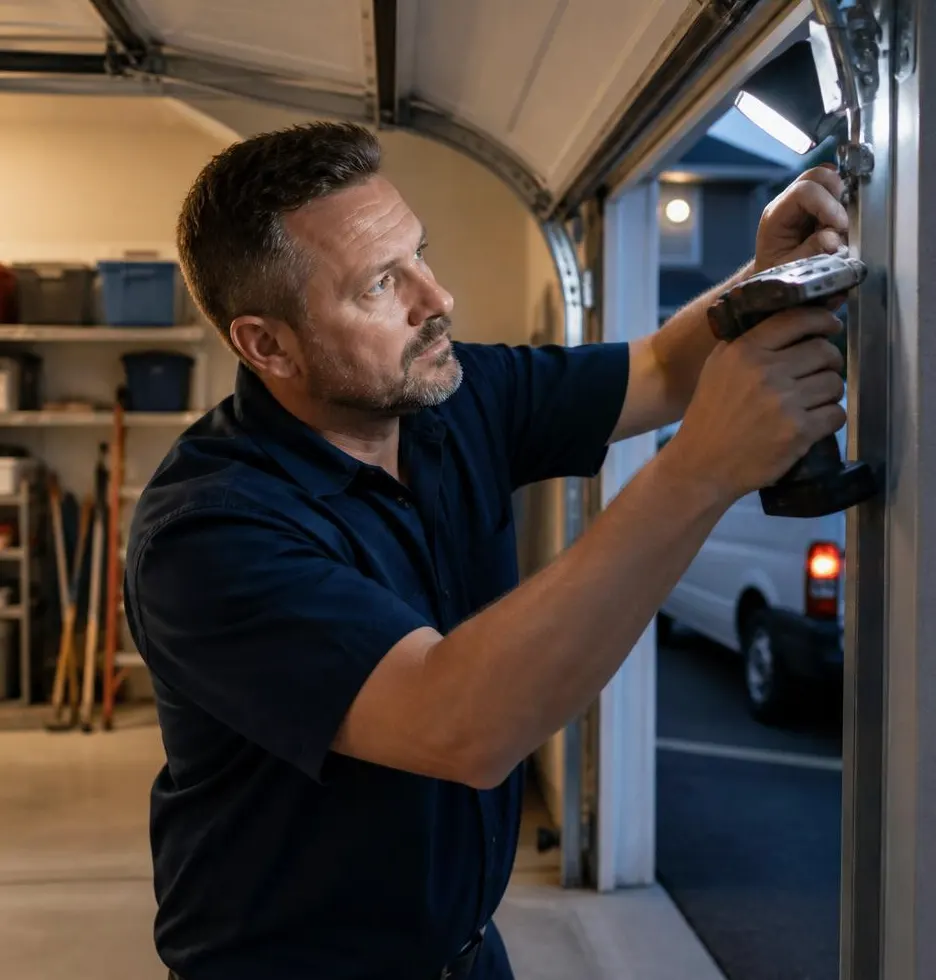
You hit the opener button on a cool December morning, coffee in hand, and the door doesn't move the way it should. It shudders, inches up an inch or two, then stalls while the motor keeps straining. Or maybe it lifts off the slab with a dull tearing sound, like something was glued to the concrete. In South Florida this isn't about ice — it's about what a cold front does after weeks of heat, humidity, and afternoon downpours. The good news is that a sluggish or stuck door almost always traces back to one of a handful of causes, and a technician checks them in a specific order.
What You're Actually Seeing
Before the causes, here's what "frozen" or sluggish looks like in a Florida garage, so you can describe it accurately if you call for service:
- The door hesitates at the bottom, then jerks upward instead of rising smoothly.
- The opener motor sounds like it's working harder than usual, sometimes with a grinding or clicking noise.
- The door reverses on its own partway up, as if something is blocking it.
- One side of the door lifts before the other, so the door looks crooked as it travels.
- The bottom seal looks like it tore or peeled away from the concrete when the door finally broke free.
- The door feels noticeably heavier when you lift it manually using the emergency release.
Cause #1: The Bottom Seal Is Bonded to the Slab
This is the one that actually feels like the door is "frozen" in place. Wellington's afternoon storms leave moisture on the driveway and garage floor. When a cool front drops overnight temperatures, that moisture doesn't evaporate as fast, and the rubber weatherstripping along the bottom of the door can suction itself to the damp concrete — especially if the seal has hardened slightly with age. The fix is straightforward: a technician inspects the seal for cracking or flattening and replaces it if it's lost its flexibility. A fresh, pliable seal flexes with temperature changes instead of gripping the slab.
Cause #2: Rollers and Tracks Loaded with Grit and Moisture
Next, a tech checks the rollers and tracks, since humidity and blowing debris from storms are constant in this area. Nylon or steel rollers collect fine dust that turns into a gummy film when it gets damp, and that film thickens and grips harder once temperatures drop a bit overnight. You'll see this as a dragging or catching motion rather than smooth travel. The fix involves cleaning the tracks with a mild degreaser, wiping the rollers down, and checking for any rust starting to form where moisture has been sitting — rust is common on hardware that sees salt-tinged air drifting inland from the coast.
Cause #3: Old or Dirty Lubricant
Lubricant that's months old doesn't flow the same way once it cools down overnight, even in a Florida winter where "cold" just means the 40s or 50s. Thickened grease on the springs, hinges, and rollers adds resistance right when the opener is trying to get the door moving, which is why the motor strains before the door even reaches the first roller. The fix is simple but often skipped: strip old, caked-on lubricant and reapply a silicone-based garage door lubricant made for the moving parts, not a general household oil that attracts dust.
Cause #4: Spring Tension That's Drifted
Springs lose a small amount of tension over time, and humidity swings accelerate surface rust on coils that aren't sealed or coated well. A spring that's even slightly under-tensioned will make the opener work harder to lift the door, and you'll notice it most on the first cold morning of the season when every other part of the system is also a bit stiffer than usual. This is not a do-it-yourself adjustment — torsion springs are under enough tension to cause serious injury. A technician measures the door's balance and adjusts or replaces the spring as needed.
Cause #5: Opener Limit Settings Thrown Off by Contraction
Metal brackets and the door itself contract slightly as temperatures drop, which can shift the opener's travel limits just enough that the sensor reads resistance too early and reverses the door, or stalls it mid-cycle. A technician checks the opener's force and limit settings last, after ruling out the mechanical causes above, since forcing an opener to compensate for a dragging door by cranking up the force setting just hides a bigger problem and strains the motor.
Cause #6: A Swollen or Warped Panel
If your door is wood or a composite material, months of humidity followed by a drier cold snap can cause a panel to swell and then shrink unevenly, leaving it slightly out of true. This shows up as binding at one spot in the track every single cycle, in the same location. A warped panel usually needs replacement rather than adjustment, since forcing it back into alignment tends to crack the material.
When to Call Wellington Garage Door Pro
If your door is sticking to the slab, dragging in the tracks, or making the opener work overtime on cool mornings, it's worth having it looked at before a spring finally gives out or the opener motor burns up trying to compensate. Our Garage Door Maintenance & Tune-Up service covers exactly this — cleaning and lubricating hardware, checking spring balance, adjusting opener limits, and replacing a hardened bottom seal before it tears. If the door is already off track or won't move at all, our Off Track Door Repair team can get it running safely the same day.
Don't wait for the first real cold front to find out your garage door isn't ready for it. Call Wellington Garage Door Pro today and let us get your door moving smoothly again, serving Wellington, Royal Palm Beach, Loxahatchee, and the surrounding Palm Beach County communities.